Hot water feels like it should be cleaning things. It’s hot. Bacteria don’t like heat. It must be doing something.
And it is doing something — just not as much as you might think, and not for the reasons most people assume.
Here’s what’s actually happening in your sink, and why the combination of hot water, soap, and the right chemistry beats hot water alone by a wide margin.
What Hot Water Actually Does
Hot water helps in several ways:
It increases solubility. Many substances dissolve more readily in hot water than cold — sugars, some proteins, starch residues. Hot water softens and loosens food residue that cold water would leave sitting there.
It speeds up chemical reactions. Every cleaning reaction — whether soap, baking soda, vinegar, or a commercial cleaner — works faster at higher temperatures. Heat is a catalyst.
It has some antimicrobial effect. Above 140°F (60°C), hot water starts killing some bacteria. However: the hot water from most home faucets maxes out around 120°F, which is well below the threshold for reliable sanitization. Your hot water is cleaning your dishes, not sanitizing them.
It helps rinse. Lower viscosity means water at higher temperatures flows off surfaces and carries debris more efficiently than cold water.
What hot water cannot do: break down grease and oil. Oil and water famously don’t mix. No amount of heat changes this fundamental chemistry.
Why Grease Needs Soap
Grease is hydrophobic — it repels water. A greasy pan rinsed with even very hot water comes out still greasy, because the grease and water simply don’t interact.
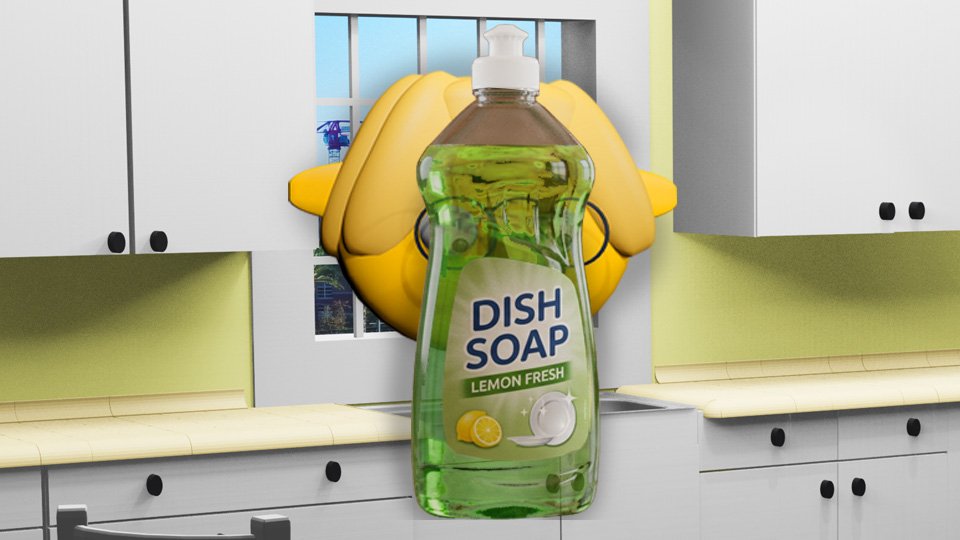
Dish soap solves this through a molecule called a surfactant. Surfactant molecules have a dual nature: one end is hydrophilic (water-loving) and one end is hydrophobic (water-hating, grease-loving). When you add soap to greasy water, these molecules orient themselves between the water and the grease — the greasy end latches onto the fat, the watery end stays in the water. As you rinse, the grease is encapsulated in tiny spheres called micelles and rinses away with the water.
This is why soap works and hot water alone doesn’t for grease. It’s not about temperature. It’s about molecular chemistry.
The Cleaning Toolkit: What Else to Know
Baking soda (sodium bicarbonate): A mild abrasive and a base. Useful for physical scrubbing without scratching, and for neutralizing acids. Good for scrubbing food residue, baked-on grease, and deodorizing. Not a sanitizer.
White vinegar (acetic acid): An acid that dissolves mineral deposits (hard water scale, calcium buildup), cuts through some greases, and has mild antimicrobial properties. The classic pair with baking soda produces a fizzing reaction that’s more dramatic than functional — the neutralization is the reaction, and neutralizing both the acid and the base leaves you with mostly water and sodium acetate. The fizz looks impressive; the chemistry is somewhat self-defeating. Use them separately for best results.
Hydrogen peroxide (3%, drugstore variety): An oxidizer with real antimicrobial properties. Used after soap washing to sanitize surfaces. It breaks down into water and oxygen — no harmful residue. Excellent for cutting boards and surfaces that touched raw meat.
Bleach (sodium hypochlorite): The heavy hitter. One tablespoon per gallon of water creates an effective sanitizing solution for surfaces, cutting boards, and anything that needs actual disinfection. Not a cleaner for food residue — it’s a sanitizer to use after cleaning. Rinse after application.
The Cleaning vs. Sanitizing Distinction
These two words are often used interchangeably and mean different things.
Cleaning removes dirt, food, grease, and visible residue. Soap and water clean.
Sanitizing reduces microbial populations (bacteria, viruses) to safe levels. Bleach solution, hydrogen peroxide, and certain commercial sanitizers sanitize.
For most home kitchen use, cleaning is enough. You don’t need to sanitize every dish after every meal. You do want to sanitize surfaces and boards that have contacted raw meat, fish, or poultry, and anything that will touch food without further cooking.
The protocol: clean first, sanitize after. Sanitizing something with visible food on it is much less effective — the food residue protects microbes from the sanitizer.
The Temperature Sweet Spot
For washing dishes: as hot as is comfortable for your hands. Hotter is more effective at loosening and removing food residue, but you’re working with your hands in this water. The soap is doing the heavy lifting regardless.
For rinsing: hot works, but cold rinse is perfectly adequate. The soap has already done its job.
For sanitizing: follow the product directions. Most sanitizing solutions work at room temperature.
🛒 Gear Worth Having
- Dawn Platinum Dish Soap — Widely considered the best dish soap for grease-cutting. The surfactant concentration is high.
- Mrs. Meyer’s Clean Day Dish Soap — Plant-based surfactants, pleasant scents, solid performance for everyday use.
- Arm & Hammer Baking Soda (2-Pack) — Keep one for cooking and one for cleaning. Inexpensive and genuinely useful.
- Seventh Generation Hydrogen Peroxide Cleaner — A spray-format H2O2 cleaner for quick surface sanitizing. Safe and effective.
- Rubber Cleaning Gloves — Lets you use hotter water comfortably. Genuinely increases cleaning effectiveness by letting you tolerate higher temperatures.
As an Amazon affiliate, I earn from qualifying purchases. Thank you for supporting TumbleBump.
Recommended Reads
- Cleanup as You Go: The Secret to Not Hating Cooking
- What to Do When It’s Really Baked On
- The Microwave “Steam Bomb”
TumbleBump is part of the WhistleBump group – find the rest of the family at WhistleBump.com.
23008
©2026 John D Reinhart/TumbleBump.com – all rights reserved