
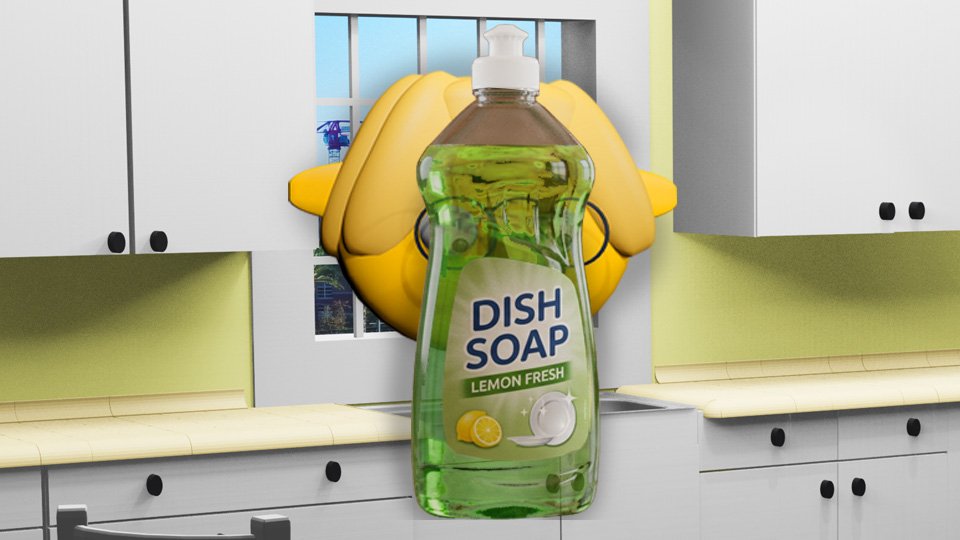
Soap is soap, right? Cleaning agent, add water, things get clean?
Not exactly. Dish soap is a distinct product category, specifically engineered for the particular challenges of kitchen cleaning: emulsifying cooking fats, breaking down proteins, suspending food particles, cutting through the grease residue that coats every pan and dish after cooking. Regular soap doesn’t do all of this as effectively.
Here’s what’s actually in that squeeze bottle, why it works, and what the real differences between products actually mean.
What Dish Soap Is Made Of
The core of every dish soap is a surfactant blend — molecules with a split personality, one end water-loving (hydrophilic), one end water-hating (hydrophobic). These are the molecules that make oil and water compatible, as described in Chemistry in the Sink.
But dish soaps also contain:
Additional surfactants: Most modern dish soaps blend multiple types — anionic surfactants for grease cutting, nonionic surfactants for gentleness, amphoteric surfactants for foam and skin compatibility.
Enzymes (in some formulas): Specific enzymes target specific food residues. Proteases break down proteins (egg, meat residue). Amylases break down starches. Lipases break down fats. Enzyme-containing dish soaps are more effective on food residue but also more expensive.
pH adjusters: Most dish soaps are mildly alkaline, which helps saponify (break down) fats. The alkalinity is gentle enough for skin with prolonged exposure, unlike household cleaners that are more aggressively alkaline.
Chelating agents: These bind hard water minerals (calcium, magnesium) that would otherwise interfere with the surfactant’s performance, making soap less effective in hard water areas.
Foam boosters: Because consumers associate foam with cleaning power. This is partly psychological — foam doesn’t clean anything directly — but foam does help distribute soap across a surface and provides useful visual feedback about soap concentration.
Preservatives, colorants, fragrances: For shelf stability and aesthetics.
Why Dish Soap Cuts Grease When Regular Soap Doesn’t (As Well)
Cooking grease is a particularly challenging cleaning target. It’s not a thin layer — it polymerizes with heat into a partially solidified coating that adheres strongly to surfaces. Regular soap handles light oils adequately. Dish soap is formulated with higher concentrations of the specific surfactants that work on cooking fats.
Dawn’s famous performance in cleaning birds after oil spills is a real demonstration of its grease-cutting capacity — the formulation was designed around high-performance fat emulsification, and it genuinely outperforms most competitors and all non-dish soaps at this.
Does Brand Actually Matter?
Yes, meaningfully so — for grease cutting.
In independent testing, Dawn Platinum consistently performs at the top for grease-cutting efficiency. This translates to less soap needed per dish, fewer passes to clean greasy pans, and a pan that actually feels clean (not slick) after rinsing.
Cheaper dish soaps often have lower surfactant concentrations and more water filler. You use more product per wash. Over time, the cost difference narrows or inverts.
That said: for lightly soiled dishes, any dish soap works fine. The brand difference is most pronounced on heavy cooking residue — greasy pans, baked-on food, protein residue.
Concentration: The Number Nobody Looks At
Dish soaps vary widely in concentration. A highly concentrated product like Dawn Platinum requires less per wash than a standard-concentration product. The bottle may cost more per ounce but produce far more washes per bottle.
The practical advice: if you’re cost-comparing dish soaps, compare cost per wash rather than cost per ounce. The concentrated products often win.
Hand Dish Soap vs. Dishwasher Detergent: Not Interchangeable
This is worth stating clearly: dish soap (the kind by the sink for hand washing) is not interchangeable with dishwasher detergent.
Hand dish soap is designed to foam heavily — the foam is part of how it works and how it signals to the user that soap is present. Put hand dish soap in a dishwasher and you will have a foam situation in your kitchen. The dishwasher will foam uncontrollably and overflow. This is a genuine mess.
Dishwasher detergent is formulated to clean without foaming, at the temperatures and water pressures specific to dishwasher cycles. It’s a completely different product.
Antibacterial Dish Soap: Worth It?
Antibacterial dish soaps contain triclosan or other antimicrobial agents that kill bacteria in addition to removing them. The practical value of this is debated.
For most dish washing, physically removing food, grease, and bacteria with regular surfactant-based soap and rinsing thoroughly accomplishes the same safety outcome as killing bacteria. You don’t need to kill the bacteria if you’ve removed them from the surface.
Antibacterial soap has a role for surfaces that need sanitizing (cutting boards after raw meat) but the FDA has raised questions about the long-term effects of triclosan and its contribution to antibiotic resistance. Regular dish soap is the default; antibacterial soap is a specific tool for specific situations.
The One Dish Soap Rule
Whatever dish soap you use, dilute it less than you think you need to. A common habit is squeezing soap directly onto every dish, producing far more soap than necessary and requiring more rinsing. Instead: a squirt into hot water creates a sudsy washing solution you dip dishes into, and stretches your soap much further.
Alternatively, use a soap dispensing dish brush — the reservoir releases exactly the right amount of soap per brush of a surface.
🛒 Gear Worth Having
- Dawn Platinum Advanced Power Liquid Dish Soap — The grease-cutting benchmark. Use less per wash and save money in the long run.
- Mrs. Meyer’s Clean Day Dish Soap — Plant-derived surfactants, excellent scents, strong performance for everyday use. The values-driven alternative.
- Seventh Generation Free and Clear Dish Soap — Fragrance-free, plant-based, effective. For sensitive skin or scent-free households.
- OXO Good Grips Soap Dispensing Dish Brush — Makes soap application controlled and efficient. The right amount, every time.
- Grove Co. Dish Soap Concentrate Refill — Ultra-concentrated. One bottle makes several standard bottles’ worth. The cost-per-wash math is excellent.
As an Amazon affiliate, I earn from qualifying purchases. Thank you for supporting TumbleBump.
Related Reads
- Chemistry in the Sink: Why Hot Water Isn’t Enough
- Cleanup as You Go: The Secret to Not Hating Cooking
- Does This Go in the Dishwasher?
TumbleBump is part of the WhistleBump group – find the rest of the family at WhistleBump.com.
23000
©2026 John D Reinhart/TumbleBump.com – all rights reserved