
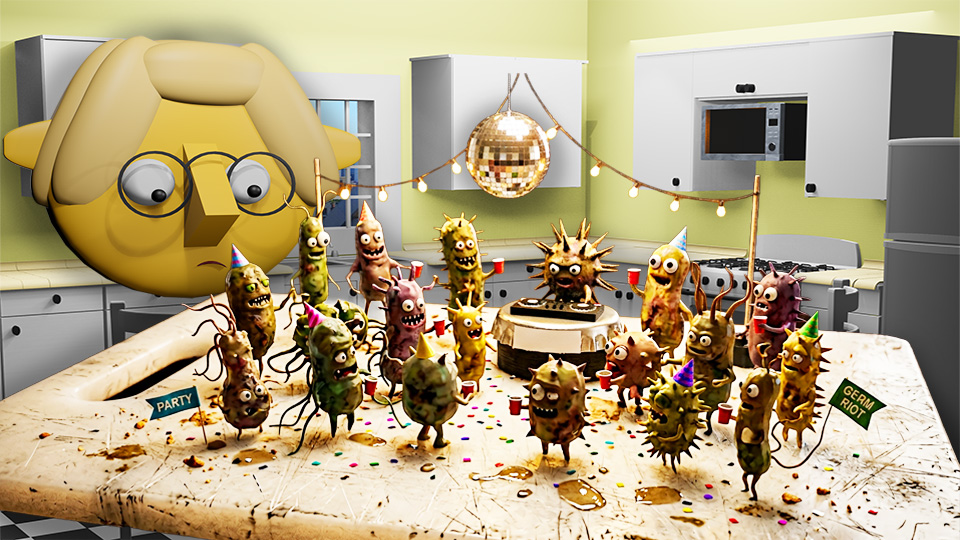
The cutting board is where most of your kitchen work actually happens. It’s where onions get diced, chicken gets sliced, herbs get chopped, and whatever you’re making gets its first real attention.
It’s also, consequently, where a lot of things accumulate that you’d rather not think about.
The good news: cutting board cleaning is not complicated. It just requires knowing a few things that nobody thinks to mention until something goes wrong.
The Two Types of Cutting Board, and Why It Matters
Wood and bamboo boards are porous. They absorb liquids, which means they can harbor bacteria in their fibers if not cleaned properly — but they also self-sanitize over time due to the natural antimicrobial properties of wood. They should never go in the dishwasher (they’ll warp, crack, and split). They need occasional oiling to stay in good condition.
Plastic boards are technically easier to sanitize and dishwasher-safe, but they develop knife grooves over time, and those grooves become excellent hiding places for bacteria that are very difficult to remove even with scrubbing. A heavily grooved plastic board is arguably less hygienic than a well-maintained wood one.
The practical conclusion: both work fine if properly maintained. Know which type you have, because the care is different.
The Basic Wash: After Every Use
For everyday cleaning after non-raw-meat use:
- Scrape off any food debris with a bench scraper or the back of your knife.
- Wash with hot, soapy water — both sides, not just the top.
- Rinse thoroughly.
- Stand upright or prop on its edge to air dry. Don’t lay it flat — water pools underneath and promotes warping and mold.
That’s it. Two sides, both washed, stood up to dry.
Why both sides? If only one side gets wet consistently, the board warps as one side absorbs moisture and the other doesn’t. A warped board rocks on the counter. A rocking board is an unstable board. Wash both sides.
After Raw Meat, Poultry, or Fish: Step It Up
Raw proteins require more than soap and water. After cutting raw meat on any board:
Option A (plastic or any board): Wash with hot soapy water, then sanitize. A simple sanitizing solution: 1 tablespoon of liquid chlorine bleach diluted in 1 gallon of water. Apply, let sit 2–3 minutes, rinse thoroughly, air dry.
Option B (any board): A spray of undiluted white vinegar followed by a spray of 3% hydrogen peroxide (standard drugstore variety). These work in sequence, not combined. Let each sit briefly, rinse. This is effective and leaves no chemical aftertaste.
The cardinal rule: Raw chicken gets its own board, or at minimum gets the full sanitizing treatment before the board touches anything else. This is the one non-negotiable in cutting board hygiene.
Deodorizing: When It Smells Like What You Cut
Onion, garlic, fish — these aromas linger in wood boards long after washing. The fix:
Salt and lemon: Sprinkle coarse salt generously over the board. Cut a lemon in half and use it to scrub the salt into the surface, squeezing as you go. Let sit 5–10 minutes, scrape off, rinse. The salt abrades, the lemon acid neutralizes odors and brightens the wood. This also works beautifully as a periodic cleaning treatment even without odor issues.
Baking soda paste: Make a paste with baking soda and a little water, scrub, let sit, rinse. Effective and gentle.
Deep Cleaning and Stain Removal
For stubborn stains (beet, berry, turmeric — the chromatic troublemakers):
A paste of baking soda and hydrogen peroxide, applied to the stain, left for 15–20 minutes, then scrubbed and rinsed. For wood boards, this works better than bleach, which can dry out and crack the wood.
For plastic boards with heavy staining: the dishwasher (if labeled dishwasher-safe) plus a pre-treatment of hydrogen peroxide paste.
Oiling Wood Boards: The Maintenance Nobody Does
This is the most skipped cutting board task and one of the most important for wood board longevity.
About once a month (or whenever the wood looks dry or pale), apply a liberal coat of food-grade mineral oil. Rub it in with a cloth in the direction of the grain. Let it soak in for a few hours or overnight. Wipe off the excess.
This prevents drying, cracking, and warping. It makes the board more resistant to staining. And it extends the board’s life from “a few years” to “potentially decades.”
Use food-grade mineral oil specifically. Olive oil, vegetable oil, and other culinary oils will go rancid inside the wood and eventually make your board smell sour. Mineral oil doesn’t. It’s cheap and available at any pharmacy.
When to Replace It
- Plastic boards: When the knife grooves are deep and numerous. If you can’t get them clean-looking after washing, it’s time.
- Wood boards: Almost never, if properly maintained. Serious cracks or mold that won’t budge despite treatment are the only real reasons.
- Bamboo boards: Similar to wood, but bamboo is harder and cracks more readily if dried out. Oil them, and they’ll last.
🛒 Gear Worth Having
- John Boos Maple Cutting Board — The gold standard of wood cutting boards. Thick, durable, and beautiful.
- OXO Good Grips Plastic Cutting Board Set — Color-coded for different food types (red for meat, green for vegetables). Practical and dishwasher-safe.
- Howard Products Food Grade Mineral Oil — The correct conditioning oil for wood boards. A bottle lasts for years.
- OXO Bench Scraper — For clearing debris off the board between tasks and after use. One of the most underrated kitchen tools.
- Clorox Clean-Up Spray — For post-meat sanitizing of plastic boards and surrounding counters. Keep it under the sink.
As an Amazon affiliate, I earn from each qualified purchase. Thank you for supporting TumbleBump.
Related Reads
- Why Wood Wins: The End-Grain Cutting Board
- The Essential Kitchen Knifes
- Cleanup as You Go: The Secret to Not Hating Cooking
TumbleBump is part of the John D Reinhart content family. Writer, illustrator, videographer, and accidental filmmaker — find the whole story at JohnDReinhart.com.
23015
©2026 John D Reinhart/TumbleBump.com – all rights reserved

 tumblebump.com