
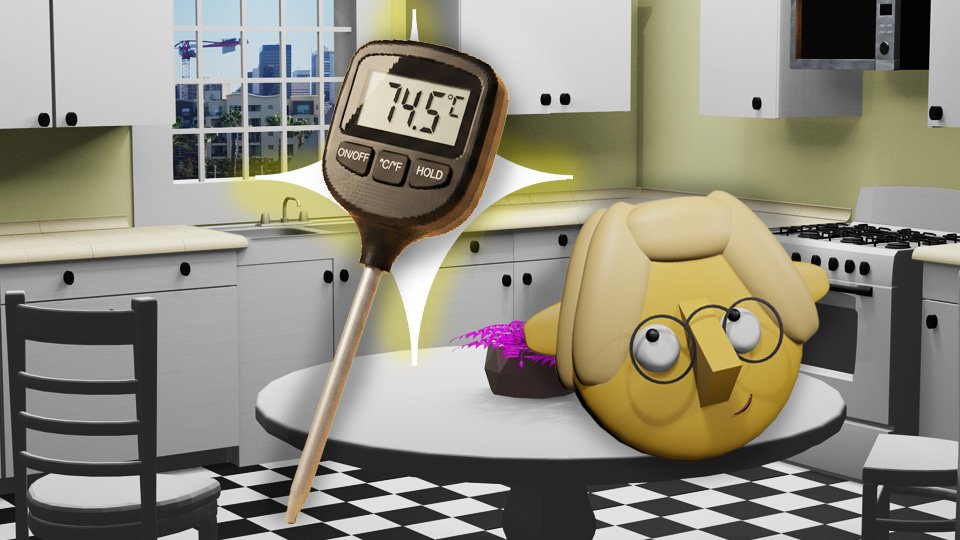
The instant-read thermometer is the single piece of kitchen equipment most likely to immediately and measurably improve your cooking. Not a better pan, not a sharper knife, not a more powerful blender. The thermometer.
Here’s why: all of the uncertainty around cooking meat, fish, bread, and candy comes from not knowing the internal temperature. Is the chicken done? Is the steak medium-rare? Is the bread baked through? Without a thermometer, you’re guessing — cutting things open, pressing with a finger, using timing estimates for a specific oven on a specific day. With a thermometer, you know. Every time.
What “Instant-Read” Actually Means
An instant-read thermometer provides a temperature reading within seconds of insertion, rather than requiring 30+ seconds to stabilize like older probe thermometers. The best instant-read thermometers (ThermoWorks Thermapen, for example) read in under 2 seconds. This is practically useful — you can check multiple spots in a roast quickly, monitor a sear without losing significant heat from the pan, and get readings without committing the thermometer to a specific position.
An instant-read is distinct from a leave-in probe thermometer, which stays in the meat throughout cooking and monitors temperature continuously. Both are useful; the instant-read is the more essential of the two.
The Features That Actually Matter
Speed: Under 3 seconds to a stable reading is genuinely useful. Slower thermometers require holding the probe in the food longer, which is inconvenient and introduces more thermal error.
Temperature range: For kitchen use, a range of at least -58°F to 572°F (-50°C to 300°C) covers everything from frozen food to candy-making.
Accuracy: ±0.5°F (±0.3°C) is the standard to look for. The difference between 160°F and 165°F is food safety; the thermometer needs to be accurate enough to make that distinction reliable.
Auto-rotating display: The reading should be visible regardless of whether you’re approaching the food from the left or right, from above or below. Thermometers with fixed displays are awkward to read in many real-world positions.
Folding probe: Protects the probe during storage and makes the thermometer pocket-safe for grill use.
IP rating (waterproofing): Kitchen thermometers get wet. An IPX7 or similar waterproofing rating means the thermometer survives splashes and accidental submersion without damage.
Backlit display: Useful when checking temperatures in dim ovens or at the grill.
The Two Tiers
Professional tier (ThermoWorks Thermapen ONE, $105): Sub-second readings, ±0.5°F accuracy, waterproof, auto-rotating, backlit. The professional standard. Worth every dollar for anyone who cooks seriously and often.
Budget tier (ThermoPro TP19H, $20–30): 2–3 second readings, ±0.9°F accuracy, waterproof, foldable. Excellent performance at an accessible price. The right starting point.
The gap between these is real but not dramatic for home use. The Thermapen is a precision instrument; the ThermoPro is a very good kitchen tool. Both are enormously better than no thermometer.
Using It Correctly
Insert at the thickest part. Not the thin edge of a chicken breast; the center of the deepest part, away from bone (bone conducts heat differently and gives a false reading).
Check multiple spots in large roasts. Temperature is not uniform. A 5-pound roast can vary significantly between the exterior and center.
Account for carryover cooking. Temperature rises 5–10°F after removing from heat as residual warmth distributes. Pull proteins 5°F before target temperature.
Calibrate occasionally. Drop the probe in ice water (32°F/0°C) to verify accuracy. If it reads differently, use the calibration function (most quality thermometers have one) or note the offset.
🛒 Gear Worth Having
- ThermoWorks Thermapen ONE — The gold standard. Sub-second, accurate, waterproof, worth it.
- ThermoPro TP19H Digital Meat Thermometer — The best budget option. Fast, accurate enough, waterproof.
- ThermoWorks ChefAlarm Leave-In Probe — The leave-in companion to the instant-read. Set an alarm temperature and let large roasts cook without hovering.
- Lavatools Javelin PRO Duo — Mid-tier option between ThermoPro and Thermapen. Excellent performance.
As an Amazon affiliate, I earn from qualifying purchases. Thank you for supporting TumbleBump.
Related Reads
- Setting Up the Cook Space: The Basic Toolkit
- The Smoke Alarm is Screaming: Oil Smoke Points
- Is it Burnt or “Cajun”? The Art of Scraping
TumbleBump is part of the WhistleBump group – find the rest of the family at WhistleBump.com.
25012
©2026 John D Reinhart/TumbleBump.com – all rights reserved