
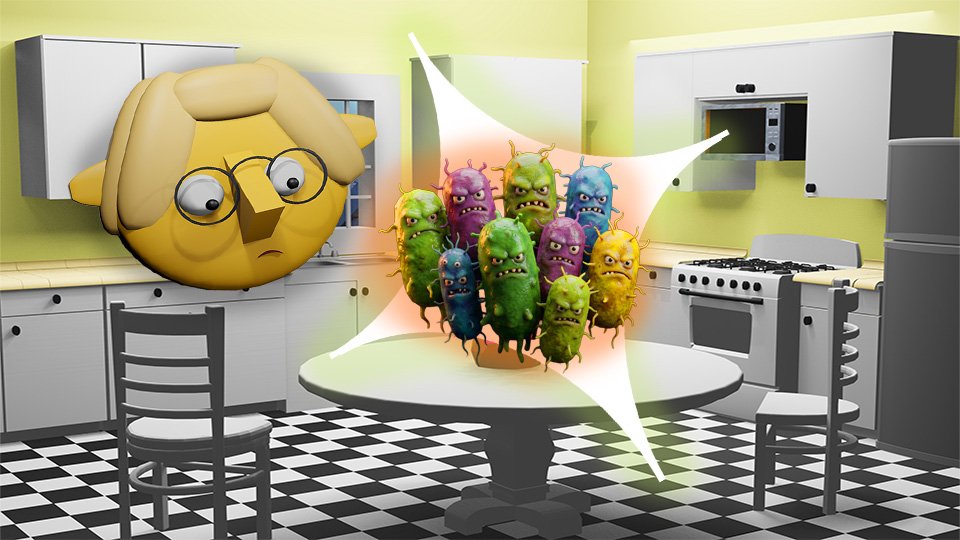
It goes like this: you open the fridge, locate a container of unknown age, pop the lid, and lean in for the sniff test. Your nose reports back. You make a decision. You have been doing this your entire adult life and you consider it a reliable system.
Here is the problem with your system: your nose has no idea what Salmonella smells like. Neither does it know E. coli, or Listeria, or any of the other invisible freeloaders that cause the kind of food poisoning that clears your entire social calendar for three days.
Your nose is excellent at detecting things that smell bad. It is completely useless at detecting things that will make you sick. These are not the same category of problem, and the gap between them is where food poisoning lives.
Your nose is not lying to you, exactly. It’s just working its own job description, which was never “food safety inspector.” It’s more of a “does this smell weird” consultant with a very limited contract.
✅ What Your Nose Is Actually Good At
Credit where it’s due. Your nose does handle some things reliably:
- Rancid fats. Old butter, stale nuts, cooking oil that’s been sitting since the last administration — oxidized fat has a sharp, almost crayon-like smell that your nose catches every time. Won’t kill you. Will taste terrible. Nose wins.
- Souring. Milk that’s turned, over-fermented yogurt, produce going fizzy in the back of the drawer. Your nose identifies sourness reliably. In early stages this is more unpleasant than dangerous, but the signal is real.
- Meat that’s gone off. Putrefaction — the smell of protein properly decomposing — is one of the most unmistakable smells on earth. If your chicken smells like that, your nose has done its job. No further consultation required.
- Mold. Musty, earthy, sharp. Often detectable before you can see it. Your nose here is actually ahead of your eyes, which is a rare compliment.
So yes. Your nose has a skill set. It’s just a very specific skill set, and “detecting dangerous pathogens” is not on the list.
❌ What Your Nose Cannot Detect (The Actual Problem)
This is the part worth paying attention to. The bacteria responsible for the most serious foodborne illness are, almost without exception, completely odorless.
- Salmonella — no smell, no visible change, no taste difference. Chicken that looks perfect, smells perfect, and tastes fine can be fully loaded with it. This is why “cook to temperature” is not optional advice.
- E. coli O157:H7 — the strain behind serious outbreak headlines produces nothing detectable in contaminated ground beef. Smells fine. Is not fine.
- Listeria — the overachiever of food pathogens. Not only odorless, but capable of multiplying in your refrigerator. Most bacteria slow down in the cold. Listeria treats your fridge like a comfortable apartment.
- Staph toxins — here’s the truly annoying one. Staphylococcus aureus produces toxins that are odorless, tasteless, and heat-stable. Meaning you can cook the bacteria out of the food and still have a problem, because the toxins they left behind are not going anywhere. The smell test and the cooking step both miss this one entirely.
The pattern: the things your nose catches are mostly unpleasant. The things your nose misses are the ones that put you in bed for three days. The smell test is a comfort, not a verdict.
🌡️ The Actual System: Time and Temperature
Food safety runs on two variables and two variables only: time and temperature. Your nose is not one of them.
- The Danger Zone — bacteria multiply rapidly between 40°F and 140°F. Food sitting in that range is accumulating a bacterial load whether it smells like anything or not.
- The Two-Hour Rule — cooked food left at room temperature for more than two hours is in risky territory. Above 90°F (hot kitchen, summer cookout), that window shrinks to one hour. Your nose will not alert you when the clock runs out.
- Your refrigerator temperature — which should be 40°F or below. Many refrigerators run warmer than their settings suggest. A $10 thermometer tells you the truth your fridge dial is not necessarily telling you.
How long is stuff actually safe in the fridge? Here’s the honest guide:
| Food | Safe Refrigerator Time |
| Cooked meat, poultry, fish | 3–4 days |
| Cooked eggs | 3–4 days |
| Soups and stews | 3–4 days |
| Cooked rice and grains | 4–5 days |
| Cooked pasta | 3–5 days |
| Deli meats (opened) | 3–5 days |
| Hard-boiled eggs (in shell) | 1 week |
| Raw ground meat | 1–2 days |
| Raw whole poultry | 1–2 days |
| Raw fish | 1–2 days |
These are conservative guidelines from actual food safety authorities, not optimistic estimates from someone who doesn’t want to throw out the leftover chicken.
🤔 The Right Way to Use Your Nose
Your nose isn’t fired. It’s just been reassigned to a supporting role.
Use it for what it’s good at: catching obvious off smells, rancidity, sourness, and the unmistakable signal of meat that has genuinely turned. Those are real signals worth heeding.
Then apply the time-temperature framework as the actual decision: How long has this been in the fridge? Was it refrigerated promptly? Do I actually know when this went in, or am I just hoping?
“It smells fine” is supporting evidence. The date on the container is the verdict.
And when the date is uncertain, when the storage history is murky, when you’re standing there genuinely unsure — the professional food safety answer is throw it out. Not because it’s definitely dangerous. Because the cost of guessing wrong is a very bad 48 hours, and leftovers are not worth that math.
🛒 The Gear That Replaces the Guesswork
- Refrigerator thermometer — Confirms your fridge is actually running at 40°F or below. Many aren’t. Ten dollars, removes all doubt, immediately more useful than your nose.
- Dry-erase fridge labels — Write the date on every container that goes in the fridge. The smell test becomes completely unnecessary when you know exactly how old something is. Revolutionary in its simplicity.
- Instant-read thermometer — For confirming cooked meat reaches safe internal temperatures. The smell test never applies to raw meat. Temperature does. Every time.
- Airtight food storage containers — Proper sealing slows bacterial growth and prevents cross-contamination. Also, you can actually see what’s in them, which helps with the dating situation considerably.
As an Amazon affiliate, I earn from qualifying purchases. Thank you for supporting TumbleBump.
✨ The Bottom Line
Your nose is a fine nose. It has served you well in many situations. It has kept you from drinking sour milk and eating rancid butter and standing too close to certain people on public transportation.
It is not, however, a food safety system. It never was. It just got promoted into that role by default because nobody posted the actual rules on the fridge.
Now you have the actual rules. Date your containers. Know your fridge temperature. Respect the two-hour window. When in doubt, throw it out.
Your nose can have its old job back. It was never qualified for this one.
📚 Related Reads
- The Is It Done? Checklist
- The Egg and You: A Relationship Worth Fixing
- How to Step Away from Fast Food and Instantly Make Your Life Better
TumbleBump is part of the WhistleBump group – find the rest of the family at WhistleBump.com.
24002
©2026 John D Reinhart/TumbleBump.com – all rights reserved