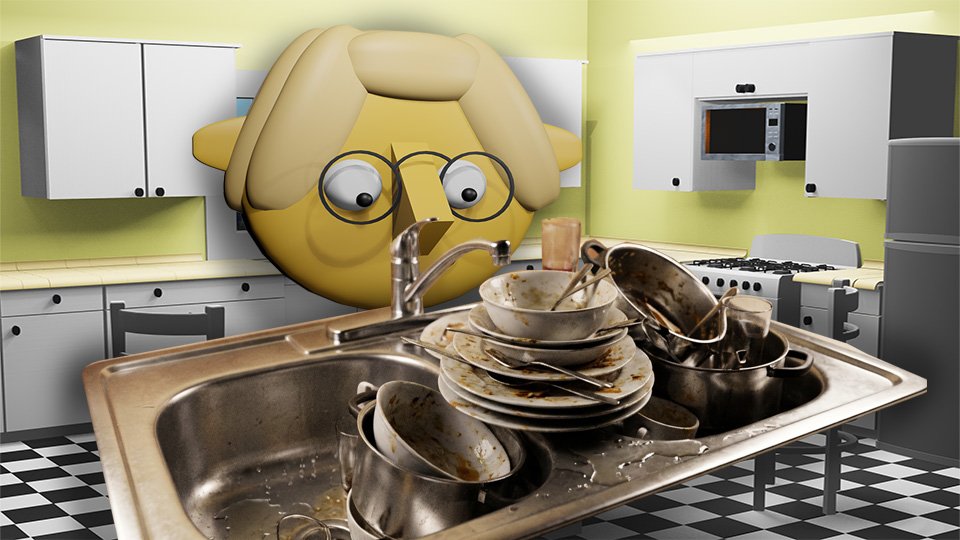
Here is the worst version of kitchen cleanup: you cook a meal, eat the meal, feel pleasantly full, turn around, and behold the disaster zone you’ve created. Every pan is dirty. Every surface has something on it. The sink is a geological formation of dishes. And now you have to deal with all of it while you’re full and tired and would like very much to not be in the kitchen right now.
This version of cleanup is a consequence of a specific approach to cooking — the approach where you do all the cooking, then all the eating, then all the cleaning, in three separate and sequential phases.
The Sink is the Finish Line philosophy changes the sequencing. And it changes everything.
The Philosophy
The Sink is the Finish Line means exactly this: getting something to the sink (or dishwasher) is the goal, not washing it. And you work toward that goal continuously, throughout cooking, rather than all at once at the end.
That’s it. That’s the whole idea.
Every time a bowl or utensil or cutting board is done being used, it goes to the sink immediately. You don’t set it “aside” — you move it. Not washed, necessarily. Just there. At the finish line.
At the end of cooking, the counter is clear. The sink has things in it, but they’re all there. The big job of washing is smaller because the big job of gathering and organizing is already done. And often, many of the things at the sink can be soaked or rinsed while you eat, making post-meal cleanup a 5-minute task instead of a 30-minute one.
Why This Works Psychologically
Cleanup feels overwhelming in proportion to its visual footprint. A counter covered in scattered dishes, bowls, and utensils looks like a project. The same mess concentrated in the sink looks like dishes. Dishes you can deal with.
Moving things to the sink continuously removes the visual overwhelm progressively, throughout the cooking session. You never arrive at the end of the meal facing the full horror of a scattered kitchen. You arrive facing a sink of dishes, which is a known and manageable quantity.
The Four Moves
Move One: The Bowl Drop Every time you finish using a mixing bowl, measuring cup, or prep container, walk it to the sink. Not the counter. The sink.
Move Two: The Utensil Round-Up Keep a narrow vessel (a tall glass, a small pitcher, a jar) near the stove for used utensils — spoons, spatulas, whisks. They collect there instead of all over the counter. At the end of cooking, the vessel goes to the sink.
Move Three: The Cutting Board Transit When you’re done with the cutting board, it goes to the sink or leans against it. The counter where it was sitting is now clear.
Move Four: The Pot and Pan Parking Finished using a pot or pan but it’s still hot? Set it on a cold burner or trivet. When it’s cool enough to handle, it moves to the sink. You don’t wash it mid-cook — you just relocate it out of the workspace.
The Soaking Strategy
Some things don’t need to be washed immediately — they need to soak. The Sink is the Finish Line philosophy pairs naturally with strategic soaking.
Any pan with baked-on or stuck food: fill it with hot water the moment you’re done using it (or done with dinner) and let it soak while you eat. By the time you return, what would have been a 10-minute scrubbing job is a 2-minute one.
Soaking while you eat is one of the most effective free productivity moves in domestic life.
The End-of-Meal State
When you sit down to eat, your kitchen should look like this: stove somewhat present, a few residual things on the counter, the sink containing essentially everything that’s been used. The workspace is mostly clear. The mess is contained.
When you finish eating, you return to a sink full of things that have been soaking, a counter that needs a quick wipe, and a kitchen that’s 80% done already.
The last 20% — washing the dishes, wiping down the stove and counters — takes 10–15 minutes. Not because dishes are easier to wash. Because the organizational work is already done.
The Counter Wipe as Punctuation
The final move of any cooking session is a single, deliberate counter wipe — one pass with a damp cloth or sponge across all surfaces, removing crumbs and spills. This takes 60 seconds and transforms the kitchen from “mostly clean” to “clean.”
The counter wipe is the period at the end of the cooking sentence. Do it every time, and the kitchen never gets away from you.
🛒 Gear Worth Having
- OXO Stainless Utensil Holder — The vessel for collecting used utensils during cooking. Keeps them off the counter and corralled.
- Silicone Pot Holder and Trivet Set — For parking hot pans safely while they cool before transit to the sink.
- Full Circle Cellulose Sponge Cloths — For the counter wipe. They absorb well, wring out easily, and hold up to daily use.
- Dish Drying Rack Over the Sink — Dishes air-dry directly over the sink, leaving the counter clear. An elegant space-saving solution.
- OXO Bench Scraper — For sweeping debris off counters and cutting boards directly into the sink or trash. One swipe, done.
As an Amazon affiliate, I earn from each qualifying purchase. Thank you for supporting TumbleBump.
Related Reads
- Cleanup as You Go: The Secret to Not Hating Cooking
- Why Dish Soap Is Different
- Chemistry in the Sink: Why Hot Water Isn’t Enough
TumbleBump is part of the WhistleBump group – find the rest of the family at WhistleBump.com.
23013
©2026 John D Reinhart/TumbleBump.com – all rights reserved